[As usual, this article can be found here at timetokeepscore.com]
This article from the WSJ raised a different critique of how the President is handling the stimulus, and it begs the question: where are the politics of hope?
The President's ability, unique among all other political leaders in the nation, to be a lone voice of policy and to so capture the public attention gives the office an enormous power to frame the issues and the debate. The article points to how the President's rhetoric in pushing for Congressional support of the stimulus paints the current economic crisis as the worst since the Great Depression.
The basic formula for President Obama's pleas is, "If we don't pass this stimulus right now, the next Great Depression will come."
I'm not a fan, especially since the average consumer's ability to spend hasn't changed too much, and his or her desire to do so is based largely on their outlook for the future. Barack ran a masterful campaign full of positive imagery and inspiring messages.
Although they were a bit lofty and dangerously vague and misleading for my taste, I can't deny the man's ability to move a room, though he does tend to fare better in a room already prone to love him. I'd love to see him change his tone from "If we don't pass this stimulus now, the Greater Depression will come," to:
"We can get out of this. We will get out of this. Hang in there. Have faith in America's innovation, its ability to push beyond temporary difficulties. Though for many of us these times have brought and will continue to bring hardship that seems impossible to bear. The rest of us need to pick up the slack and find ways to support those in need. In the meantime, we feel that this stimulus package is the best shot we have to help right the economic ship while leaving behind a footprint of valuable programs [aside: I personally argue with that notion, but that's at least what he's trying to argue] to benefit an America struggling and an America prosperous."
Anyway, I call on the President to see through his campaign of inspiration. I didn't vote for you, Barack, but I'm waiting to be inspired.
[Read the article for some of the key facts around which the President may be slightly guilty of hyperbole, and the economic reasons why this is counterproductive though there may be a political upside. Okay, really guilty of hyperbole. Also, I caught an article last week but can't find it that discussed how, in one of many instances where Dubya just couldn't win, he attempted early in his presidency to paint how much trouble our economy was in post-9/11 and was accused of fear-mongering, and while afterward when he responded with unrelenting optimism he was accused of ignoring the 'horrible truth,' but I can't find it. Anyone catch that article and can post a link to it?]
Showing posts with label economy. Show all posts
Showing posts with label economy. Show all posts
Monday, February 16, 2009


Friday, November 14, 2008
It's OUR Job...
I came across this bit of numbers from Pew, and thought I'd pass this on. According to a recent study, 57% of Americans either mostly or completely agree that it's the government's job to care for the needy.

I want to clarify one thing. It's NOT the government's job to care for the needy. That implies that it's "someone else's" job. It's all of our jobs to care for the needy. All of us.
This is about as preachy as I'm willing to get, but I despise the notion that conservatives somehow have it in for the poor, the less fortunate, minorities in difficult situations, etc. when that's not usually the case. What is the case is that there is a strong mistrust of the government's ability to create and administer effective programs for the kind of relief that's needed that will most promote permanent extraction from a bad situation.
That being said, we cannot nor should not allow the existence of such problems to provide an excuse for not doing our part, nor should we assume that the government bears that responsibility alone. It's our job.

I want to clarify one thing. It's NOT the government's job to care for the needy. That implies that it's "someone else's" job. It's all of our jobs to care for the needy. All of us.
This is about as preachy as I'm willing to get, but I despise the notion that conservatives somehow have it in for the poor, the less fortunate, minorities in difficult situations, etc. when that's not usually the case. What is the case is that there is a strong mistrust of the government's ability to create and administer effective programs for the kind of relief that's needed that will most promote permanent extraction from a bad situation.
That being said, we cannot nor should not allow the existence of such problems to provide an excuse for not doing our part, nor should we assume that the government bears that responsibility alone. It's our job.
Friday, November 7, 2008
Daylight Savings Time is a Crock
Once again, Freakonomics is there to tell us how it really is. Thanks to Freakonomics blogger Stephen J. Dubner for finding this article providing good science in support of the notion that Daylight Savings Time is, in fact, a crock and a waste.
It's an interesting premise, but sadly a bit of a boring read unless you're really in to quantitative analysis where the bulk of the writing is just explaining the methodology behind the research; it's important for good science, but painful to read. In a nutshell, these Ph.D. types reminded us all that, contrary to popular belief, Daylight Savings Time isn't about agriculture at all, but it's supposedly about keeping energy costs down by playing with the energy demand.
They did a study of Indiana who until recently left it up to the individual counties to decide whether they would practice DST. What's more, the poor hoosiers have the time zone divide going right down the middle of their state. Anyway, because they recently passed a law that all counties had to practice DST, they have a pretty good natural laboratory to compare average energy consumption.
Our main finding is that—contrary to the policy’s intent—DST results is an overall increase
in residential electricity demand. Estimates of the overall increase in consumption are
approximately 1 percent and highly statistically significant. We also find that the effect is not
constant throughout the DST period: there is some evidence for an increase in electricity demand at the spring transition into DST, but the real increases come in the fall when DST appears to increase consumption between 2 and 4 percent.
On a personal level, I've never liked the time change because I find the abrupt transition to standard time in the fall a bit jarring. It always happens just as the weather's starting to get cooler and the general look of the season a bit more bleak. The sun sits lower in the sky anyway, there are significantly fewer leaves on the trees, it's cold and flu season, etc. My personal favorite is when I arrive at work before the sun's up and don't leave until the sun's down. As a child of summer and something of a sun-worshiper, it's just too much of a change. I'm pretty sure I suffer from seasonal depression anyway and this isn't helping.
But wait: I discovered yet another reason not to love the time change: the Daughter pays more attention to the sun than the clock. So, while "fall back" used to be a refreshing time to get an extra hour of sleep before Sunday's obligations began, this year--the Daughter's first--it became an opportunity to have an extra hour to get ready in the morning as she was up by a little after 6:00 instead of her previous a little after 7:00. Yeesh.
So for those of you who may be struggling to find something to get riled up about now that the elections have come and gone, let's get riled up about this: Down with DST! It has all the components of a great cause: it's easy to put on a bumper sticker, a t-shirt, or a sign to be held up at a rally. You can even apply vague rhetoric to it that sounds profound: "Keep Us Out of the Dark!" "EnLIGHTen America!" What more do you need?
It's an interesting premise, but sadly a bit of a boring read unless you're really in to quantitative analysis where the bulk of the writing is just explaining the methodology behind the research; it's important for good science, but painful to read. In a nutshell, these Ph.D. types reminded us all that, contrary to popular belief, Daylight Savings Time isn't about agriculture at all, but it's supposedly about keeping energy costs down by playing with the energy demand.
They did a study of Indiana who until recently left it up to the individual counties to decide whether they would practice DST. What's more, the poor hoosiers have the time zone divide going right down the middle of their state. Anyway, because they recently passed a law that all counties had to practice DST, they have a pretty good natural laboratory to compare average energy consumption.
Our main finding is that—contrary to the policy’s intent—DST results is an overall increase
in residential electricity demand. Estimates of the overall increase in consumption are
approximately 1 percent and highly statistically significant. We also find that the effect is not
constant throughout the DST period: there is some evidence for an increase in electricity demand at the spring transition into DST, but the real increases come in the fall when DST appears to increase consumption between 2 and 4 percent.
On a personal level, I've never liked the time change because I find the abrupt transition to standard time in the fall a bit jarring. It always happens just as the weather's starting to get cooler and the general look of the season a bit more bleak. The sun sits lower in the sky anyway, there are significantly fewer leaves on the trees, it's cold and flu season, etc. My personal favorite is when I arrive at work before the sun's up and don't leave until the sun's down. As a child of summer and something of a sun-worshiper, it's just too much of a change. I'm pretty sure I suffer from seasonal depression anyway and this isn't helping.
But wait: I discovered yet another reason not to love the time change: the Daughter pays more attention to the sun than the clock. So, while "fall back" used to be a refreshing time to get an extra hour of sleep before Sunday's obligations began, this year--the Daughter's first--it became an opportunity to have an extra hour to get ready in the morning as she was up by a little after 6:00 instead of her previous a little after 7:00. Yeesh.
So for those of you who may be struggling to find something to get riled up about now that the elections have come and gone, let's get riled up about this: Down with DST! It has all the components of a great cause: it's easy to put on a bumper sticker, a t-shirt, or a sign to be held up at a rally. You can even apply vague rhetoric to it that sounds profound: "Keep Us Out of the Dark!" "EnLIGHTen America!" What more do you need?
Thursday, October 23, 2008
Enlightened Thoughts from a Mormon Democrat: Preach On, Brother Card!
For those of you who are confused at my title, I understand. A Mormon Democrat is seen largely as a contradiction in terms, but there are more than you’d think. I happen not to be one of them, but some of my friends are. There’s even one in the Senate—the always lovable Brother Harry Reid of Nevada.
Orson Scott Card, a Democrat, writer, and Mormon recently wrote a fantastic bit of commentary about the current state of journalism in America and its overwhelmingly “forgiving” attitude of liberal politicians. Here’s the link. I tried for the life of me to excerpt it and I couldn't in good conscience leave anything out, so if you'd like to read it here, here goes:
Orson Scott Card, a Democrat, writer, and Mormon recently wrote a fantastic bit of commentary about the current state of journalism in America and its overwhelmingly “forgiving” attitude of liberal politicians. Here’s the link. I tried for the life of me to excerpt it and I couldn't in good conscience leave anything out, so if you'd like to read it here, here goes:
Would the Last Honest Reporter Please Turn On the Lights?
By Orson Scott Card
Editor's note: Orson Scott Card is a Democrat and a newspaper columnist, and in this opinion piece he takes on both while lamenting the current state of journalism.
An open letter to the local daily paper — almost every local daily paper in America:
I remember reading All the President's Men and thinking: That's journalism. You do what it takes to get the truth and you lay it before the public, because the public has a right to know.
This housing crisis didn't come out of nowhere. It was not a vague emanation of the evil Bush administration.
It was a direct result of the political decision, back in the late 1990s, to loosen the rules of lending so that home loans would be more accessible to poor people. Fannie Mae and Freddie Mac were authorized to approve risky loans.
What is a risky loan? It's a loan that the recipient is likely not to be able to repay.
The goal of this rule change was to help the poor — which especially would help members of minority groups. But how does it help these people to give them a loan that they can't repay? They get into a house, yes, but when they can't make the payments, they lose the house — along with their credit rating.
They end up worse off than before.
This was completely foreseeable and in fact many people did foresee it. One political party, in Congress and in the executive branch, tried repeatedly to tighten up the rules. The other party blocked every such attempt and tried to loosen them.
Furthermore, Freddie Mac and Fannie Mae were making political contributions to the very members of Congress who were allowing them to make irresponsible loans. (Though why quasi-federal agencies were allowed to do so baffles me. It's as if the Pentagon were allowed to contribute to the political campaigns of Congressmen who support increasing their budget.)
Isn't there a story here? Doesn't journalism require that you who produce our daily paper tell the truth about who brought us to a position where the only way to keep confidence in our economy was a $700 billion bailout? Aren't you supposed to follow the money and see which politicians were benefiting personally from the deregulation of mortgage lending?
I have no doubt that if these facts had pointed to the Republican Party or to John McCain as the guilty parties, you would be treating it as a vast scandal. "Housing-gate," no doubt. Or "Fannie-gate."
Instead, it was Senator Christopher Dodd and Congressman Barney Frank, both Democrats, who denied that there were any problems, who refused Bush administration requests to set up a regulatory agency to watch over Fannie Mae and Freddie Mac, and who were still pushing for these agencies to go even further in promoting sub-prime mortgage loans almost up to the minute they failed.
As Thomas Sowell points out in a TownHall.com essay entitled "Do Facts Matter?" ( http://snipurl.com/457townhall_com] ): "Alan Greenspan warned them four years ago. So did the Chairman of the Council of Economic Advisers to the President. So did Bush's Secretary of the Treasury."
These are facts. This financial crisis was completely preventable. The party that blocked any attempt to prevent it was ... the Democratic Party. The party that tried to prevent it was ... the Republican Party.
Yet when Nancy Pelosi accused the Bush administration and Republican deregulation of causing the crisis, you in the press did not hold her to account for her lie. Instead, you criticized Republicans who took offense at this lie and refused to vote for the bailout!
What? It's not the liar, but the victims of the lie who are to blame?
Now let's follow the money ... right to the presidential candidate who is the number-two recipient of campaign contributions from Fannie Mae.
And after Freddie Raines, the CEO of Fannie Mae who made $90 million while running it into the ground, was fired for his incompetence, one presidential candidate's campaign actually consulted him for advice on housing.
If that presidential candidate had been John McCain, you would have called it a major scandal and we would be getting stories in your paper every day about how incompetent and corrupt he was.
But instead, that candidate was Barack Obama, and so you have buried this story, and when the McCain campaign dared to call Raines an "adviser" to the Obama campaign — because that campaign had sought his advice — you actually let Obama's people get away with accusing McCain of lying, merely because Raines wasn't listed as an official adviser to the Obama campaign.
You would never tolerate such weasely nit-picking from a Republican.
If you who produce our local daily paper actually had any principles, you would be pounding this story, because the prosperity of all Americans was put at risk by the foolish, short-sighted, politically selfish, and possibly corrupt actions of leading Democrats, including Obama.
If you who produce our local daily paper had any personal honor, you would find it unbearable to let the American people believe that somehow Republicans were to blame for this crisis.
There are precedents. Even though President Bush and his administration never said that Iraq sponsored or was linked to 9/11, you could not stand the fact that Americans had that misapprehension — so you pounded us with the fact that there was no such link. (Along the way, you created the false impression that Bush had lied to them and said that there was a connection.)
If you had any principles, then surely right now, when the American people are set to blame President Bush and John McCain for a crisis they tried to prevent, and are actually shifting to approve of Barack Obama because of a crisis he helped cause, you would be laboring at least as hard to correct that false impression.
Your job, as journalists, is to tell the truth. That's what you claim you do, when you accept people's money to buy or subscribe to your paper.
But right now, you are consenting to or actively promoting a big fat lie — that the housing crisis should somehow be blamed on Bush, McCain, and the Republicans. You have trained the American people to blame everything bad — even bad weather — on Bush, and they are responding as you have taught them to.
If you had any personal honor, each reporter and editor would be insisting on telling the truth — even if it hurts the election chances of your favorite candidate.
Because that's what honorable people do. Honest people tell the truth even when they don't like the probable consequences. That's what honesty means . That's how trust is earned.
Barack Obama is just another politician, and not a very wise one. He has revealed his ignorance and naivete time after time — and you have swept it under the rug, treated it as nothing.
Meanwhile, you have participated in the borking of Sarah Palin, reporting savage attacks on her for the pregnancy of her unmarried daughter — while you ignored the story of John Edwards's own adultery for many months.
So I ask you now: Do you have any standards at all? Do you even know what honesty means?
Is getting people to vote for Barack Obama so important that you will throw away everything that journalism is supposed to stand for?
You might want to remember the way the National Organization of Women threw away their integrity by supporting Bill Clinton despite his well-known pattern of sexual exploitation of powerless women. Who listens to NOW anymore? We know they stand for nothing; they have no principles.
That's where you are right now.
It's not too late. You know that if the situation were reversed, and the truth would damage McCain and help Obama, you would be moving heaven and earth to get the true story out there.
If you want to redeem your honor, you will swallow hard and make a list of all the stories you would print if it were McCain who had been getting money from Fannie Mae, McCain whose campaign had consulted with its discredited former CEO, McCain who had voted against tightening its lending practices.
Then you will print them, even though every one of those true stories will point the finger of blame at the reckless Democratic Party, which put our nation's prosperity at risk so they could feel good about helping the poor, and lay a fair share of the blame at Obama's door.
You will also tell the truth about John McCain: that he tried, as a Senator, to do what it took to prevent this crisis. You will tell the truth about President Bush: that his administration tried more than once to get Congress to regulate lending in a responsible way.
This was a Congress-caused crisis, beginning during the Clinton administration, with Democrats leading the way into the crisis and blocking every effort to get out of it in a timely fashion.
If you at our local daily newspaper continue to let Americans believe — and vote as if — President Bush and the Republicans caused the crisis, then you are joining in that lie.
If you do not tell the truth about the Democrats — including Barack Obama — and do so with the same energy you would use if the miscreants were Republicans — then you are not journalists by any standard.
You're just the public relations machine of the Democratic Party, and it's time you were all fired and real journalists brought in, so that we can actually have a news paper in our city.
This article first appeared in The Rhinoceros Times of Greensboro, North Carolina, and is used here by permission.
Tuesday, October 14, 2008
Good Perspective on the Economy
The following is an excerpt from a recent article by professor, writer, etc. Gregg Easterbrook. I enjoyed it because it is a cry for perspective on the current financial situation, and I happen to wish that there was more of a cry for perspective from the media. I made the claim recently that this sort of down is just a part of modern economics and got called to the carpet for it by an old friend. Here's some additional reasoning for my position:
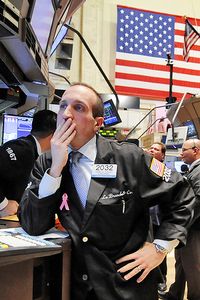
Gasoline Plentiful, Perspective Scarce: "Financial chaos is sweeping the world," a New York Times lead story said last week. I didn't notice any chaos in my part of the world -- every business was open, ATMs were working, goods and services were plentiful. There are economic problems to be sure. But chaos? Collapse? Next Depression? Please, media and political worlds, let's stop hyperventilating and show some perspective.
What is going on is a financial panic, not an economic collapse. Financial panics are no fun, especially for anyone who needs to cash out an asset right now for retirement, college and so on. But financial panics occur cyclically and are not necessarily devastating. The most recent financial panic was 1987, when the stock market fell 23 percent in a single day. Pundits and politicians instantly began talking about another Depression, about the "end of Wall Street." The 1987 panic had zero lasting economic consequences -- no recession began, and in less than two years, stocks had recouped all losses. (See John Gordon's excellent 2004 book on the history of financial panics, "An Empire of Wealth.") Perhaps a recession will be triggered by the current financial panic, but it may not necessarily be severe.
Politicians and pundits are competing to see who can act most panicked and use the most exaggerated claims about economic crisis -- yet the fundamentals of the U.S. economy are, in fact, strong. Productivity is high; innovation is high; the workforce is robust and well-educated; unemployment is troubling at 6.1 percent, but nothing compared to the recent past, such as 11.8 percent unemployment in 1992; there are no shortages of resources, energy or goods. Here, University of Chicago economist Casey Mulligan shows that return on capital is historically high; high returns on capital are associated with strong economies. Some Americans have significant problems with mortgages, and credit availability for business could become an issue if the multiple bank-stabilizing plans in progress don't work. But the likelihood is they will work. When the 1987 panic hit, people were afraid the economy would collapse; it didn't. This panic is global, enlarging the risks. But there's a good chance things will turn out fine.
Why has a credit-market problem expanded into a panic? One reason is the media and political systems are now programmed for panic mode. Everything's a crisis! Crises, after all, keep people's eyes glued to cable news shows, so the media have an interest in proclaiming crises. Crises make Washington seem more important, and can be used to justify giveaways to favored constituent groups, so Washington influence-peddlers have an interest in proclaiming crises.
An example of the exaggerated crisis claim is the assertion that Americans "lost" $2 trillion from their pension savings in the past month, while equities "lost" $8 trillion in value. "Investors Lose $8.4 Trillion of Wealth" read a Wall Street Journal headline last week. This confuses a loss with a decline. Unless you cashed out stocks or a 401(k) in the past month, you haven't "lost" anything. Nor have most investors "lost" money, let alone $8.4 trillion -- crisis-mongering is now so deeply ingrained in the media that even Wall Street Journal headline writers have forgotten basic economics. People who because of financial need have no choice but to cash out stocks right now are really harmed. Anyone who simply holds his or her ground with stocks takes no loss and is likely, although of course not certain, to come out ahead in the end. During the housing price bubble of 2003 to 2006, many Americans became much better off on paper, but never actually sold their homes, so it was all paper gains. Right now many Americans holdings stocks or retirement plans are much worse off on paper, but will be fine so long as they don't panic and sell. One of the distressing things about last week's media cries of doomsday is that they surely caused some average people to sell stocks or 401(k)'s in panic, taking losses they might have avoided by simply doing nothing. The financial shout-shows on cable tend to advise people to buy when the market is rising, sell when the market is falling -- the worst possible advice, and last week it was amplified by panic.
We've also fallen into panic because we pay way too much attention to stock prices. Ronald Reagan said, "Never confuse the stock market with the economy." Almost everyone is now making exactly that mistake. The stock market is not a barometer of the economy; it is a barometer of what people think stocks are worth. These are entirely separate things. What people think stocks are worth now depends on their guess about what stocks will be worth in the future, which is unknowable. You can only guess, and thus optimism feeds optimism while pessimism feeds pessimism.
There is no way the American economy became 8 percent less valuable between breakfast and morning coffee break Friday, then became 3 percent more valuable at lunchtime (that is, improved by 11 percent), then became 3 percent less valuable by afternoon teatime (that is, declined by 6 percent) -- to cite the actual Dow Jones Industrials swings from Friday. And the economy sure did not become 11 percent more valuable Monday. Such swings reflect panic or herd psychology, not the underlying economy, which changes over months and years, not single days. For the past few weeks pundits and Washington and London policy-makers have been staring at stock tickers as if they provided minute-by-minute readouts of economic health, which they do not. It's embarrassing to see White House and administration officials seemingly so poorly schooled in economic theory they are obsessing over stock-price movements, which they cannot control and in the short term should not even care about.
[+] Enlarge
AP Photo/Richard Drew
"It's a crisis! A calamity! The end of civilization! Say, is the limo with my champagne here yet?"
Consider this. On Black Monday in 1987, the market fell 23 percent. If you had invested $100 in a Dow Jones Index fund the following day, it would be $460 now, a 275 percent increase adjusting for inflation. That's after the big slide of the past month, and still excellent. So don't panic, just hold your stocks. And if you'd invested $100 in real estate in 1987, it would be $240 today, a 30 percent increase adjusting for inflation. That's after the housing price bubble burst. A 30 percent real gain in 20 years isn't a great investment -- until you consider that you lived in the house or condo during this time. To purchase and live in a dwelling, then come out ahead when you sell, is everyone's dream. Not only do stocks remain a good buy, America on average is still coming out ahead on the housing dream. (This example uses the Case Shiller Index for the whole country; because housing markets are local, some homeowners have lost substantial ground while others enjoyed significant appreciation.)
Economic problems are likely to be with us for awhile, but also likely to be resolved -- the 1987 panic and the 1997 Asian currency collapse both were repaired more quickly than predicted, with much less harm than forecast. Want to worry? Worry about the fact that the United States is borrowing, mainly from foreign investors and China, the money being used to fix our banks. The worse the national debt becomes -- $11 trillion now, and increasing owing to Washington giveaways -- the more the economy will soften over the long term. It's long-term borrowing, not short-term Wall Street mood swings, that ought to worry us, because the point may be reached where we can no longer solve problems by borrowing our way out. TMQ's former Brookings Institution colleague Peter Orszag, now director of the Congressional Budget Office, was on "Newshour" last week talking about the panic. Orszag is a wicked-smart economist -- for instance, he is careful to say pension holdings have declined, not been lost like most pundits are saying, as if there were no difference between decline and loss! The below exchange occurred with host Jeffrey Brown. Remember these words:
PETER ORSZAG: One thing we need to remember is we're lucky that we have the maneuvering room now to issue lots of additional Treasury securities and intervene aggressively to address this crisis.
JEFFREY BROWN: Wait a minute. Explain that. Lucky in what sense?
PETER ORSZAG: That people are still willing to lend to us. If in 20 or 30 years we continue on the same path, with rising health-care costs and rising budget deficits, we would reach a point where we wouldn't have that ability.
Thursday, October 9, 2008
My Belated Two Cents on the Financial Crisis
 I thought this was funny and worth sharing. Thanks to my buddy from the Mo-Row and neighbor Dave for passing it along.
Oddly enough, I don't have a ton to say about the crisis, so sorry if this is anti-climactic. Though who'm I kidding? It's not like anyone out there was particularly dying to hear my opinion. Besides, my buddy Bitner and his new clan of commentators have had ample to say about the crisis that trumps anything I could add.
I will say this. I'm concerned that the bailout is now being called bigger than the New Deal, when I'm at least mostly convinced that the New Deal had little to do with bringing us out of the Great Depression; World War II did that.
Naively or not, I tend to believe that these things happen and they happen every 10-15 years or so, regardless of what the politicians do. I don't believe that tax policy can affect much more than the margins of the economy. We get a bit of a confusing message, though, because when the economy goes well, whoever initiated the last big tax policy/spending plan claims victory. When it goes south, whoever opposed the plan pulls an "I told you so."
That being said, the best thing we can all do is hang in there. Resist the temptation to look at your portfolio every day to watch it wither and die, and if you've smartly saved a few extra bucks and manage a budget, if anything dump a bit more into it now. It'll bounce back. It always does. Investing in something now will make you part of the solution and you'll become a beneficiary of the relatively low prices out there now.
Tuesday, August 12, 2008
Gas is Cheaper Now Than in the Sixties?
That's right, gas is actually cheaper now than it was in the sixties. Comparatively speaking. Check out this article from the L.A. Times:
http://www.latimes.com/news/opinion/commentary/la-oe-goklany11-2008aug11,0,3798951.story
After you adjust for inflation, when you look at the price of gas relative to the amount of otherwise disposable income you have, the cost of gas actually took more out of your wallet back then than it does now. And let's not forget that we pay significantly more per gallon of bottled water than we do for gasoline. If we pay $1.25 for a 16 oz. bottle of water (which is likely just filtered water like the kind you can get out of the tap), that's roughly $10.25 per gallon that comes in one of the least environmentally-friendly packages you can ask for. Food for thought.
As my family looks at the possibility of getting a second car (something a bit safer for the ill-plowed winter streets of Denver), we're definitely worried about the increased cost of gas. Anyone have any suggestions? In the meantime, we're grateful for our Costco membership and all it lets us save on gas.
http://www.latimes.com/news/opinion/commentary/la-oe-goklany11-2008aug11,0,3798951.story
After you adjust for inflation, when you look at the price of gas relative to the amount of otherwise disposable income you have, the cost of gas actually took more out of your wallet back then than it does now. And let's not forget that we pay significantly more per gallon of bottled water than we do for gasoline. If we pay $1.25 for a 16 oz. bottle of water (which is likely just filtered water like the kind you can get out of the tap), that's roughly $10.25 per gallon that comes in one of the least environmentally-friendly packages you can ask for. Food for thought.
As my family looks at the possibility of getting a second car (something a bit safer for the ill-plowed winter streets of Denver), we're definitely worried about the increased cost of gas. Anyone have any suggestions? In the meantime, we're grateful for our Costco membership and all it lets us save on gas.
Subscribe to:
Posts (Atom)

 Posts
Posts

